News
|
Give Bees a Chance!
A battle won, but the bees are not saved from the terrible triple P
This week is the second European Bee Health Week, dubbed BeeODiversity, and it involves a conference Wednesday 5th June in the European Parliament (EP) and a fancy exhibition outside parliament all week long. The Greens/EFA group welcome every public event, debate or policy that aims to help protect bees and biodiversity, but find it quite odd that amongst the sponsors behind the organisation of Bees Biodiversity Network are pesticide company BASF and several French grain cooperatives that belong to one of the most intensive users of pesticides in the European farming sector. The Bees Biodiversity Network diverts the discussions towards less controversial risk factors such as pathogens or the lack of nutritional sources. These are certainly important factors in bee health. However, we have observed that this Network's intentions are to completely neglect any consideration of the impact of agro-chemicals and the current industrial model of farming on bees health.
Furthermore, the Bees Biodiversity Network represents no-one and nothing within the European or French beekeeping sectors or civil society. A bee health week sponsored by a company that sells products that are co-responsible for bee decline? That's way beyond green washing! The Greens/EFA group have therefore, with the support of some MEP's from other political groups, sent a letter, co-written by the European Beekeeping Coordination, PAN-Europe and Apis BruocSella, to the whole EP.
Commission decides against some pesticides
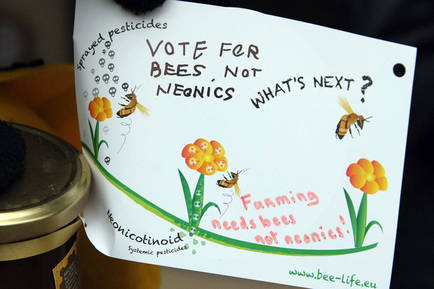
Friday 24th of May was a good day for bees and bio-diversity: the decision by the European Commission (EC) to implement EU-wide restrictions on pesticide use was officially announced and published. A first small, sweet victory for all those millions of EU citizens, beekeepers, NGO´s and politicians that over the past months fought hard for the mere survival of the policy measure that the Commission announced in January. The Greens and others have always argued that the dramatic loss of bee colonies is linked to the devastating triple P: (lack of) Pollen, Pathogens and Pesticides (which ironically is also the acronym for Plant Protection Products, or pesticides). Lack of pollen is largely linked to a certain type of (monoculture) agriculture, which is in turn linked to the very same agro-chemical companies as they sell both seeds and pesticides. The Greens were and are fighting for a shift to more sustainable forms of agriculture which would be better for ecosystems and biodiversity, crucial for the production of good quality and healthy foods. But in the short term, banning pesticides is the most effective measure politicians can take. So restrictions on the use of three pesticides (clothianidin, imidacloprid and thiametoxam) belonging to the neonicotinoid family will enter into force on the 1st December, because they were identified by the European Food Safety Authority (EFSA) as being harmful to Europe’s honeybee population. This ban targets pesticides used in the treatment of plants and cereals that are attractive to bees and pollinators but will last for only two years. And the Commission announced that it will also be reviewed, at the latest, within those two years, most likely to keep fierce legal action by Syngenta, Bayer & co at bay.
Evidence against neonicotinoids continues to grow
These neonicotinoids are extremely toxic; independent scientific studies have shown (Bonmatin, 2009) that they are a few thousand times more toxic than the legendary chemical DDT - and stay active in the soil and water for a long time. The half life time of Imidacloprid, for example, is between 40 and 997 days. And it was a study by Bayer Crop Science itself that showed only 20% of the neonicotinoid is absorbed by the plant, and thus 80% is washed away into the environment. Yet scientists know that per hectare of corn an average of 75 gram of imidacloprid is used, while 3.7 nanogram is already the lethal dose for 50 honeybees.