Letters from Lviv, Ukraine – MEP Erik Marquardt visits the Polish-Ukrainian border

The humanitarian consequences of Putin’s war on Ukraine have been devastating. Almost three million people have fled their homes to seek safety in the EU. Since the war began, 75,000 children a day have become refugees, according to the United Nations (UN). Greens/EFA MEP Erik Marquardt visited the border between Ukraine and Poland in early March to find out about the situation on the ground.

The first thing I saw, driving to the border crossing point of Kroscienko in Poland, was a long queue of cars and vans. Hundreds of them. All waiting to bring donations to Ukraine.

Standing at the border, a steady stream of women, children and elderly people were arriving on foot. Most of them were waiting for relatives or friends to pick them up. A makeshift reception tent was handing out hot tea, food and essentials. People told me about their long journeys on trains, buses and in cars – often over several days – within Ukraine. And five to six hour waits – on that day – in the cold to enter the European Union. Just to be safe.

Goodbye at the EU border – families separated by Putin’s war

As I went further north to the border crossing of Medyka, I saw more and more people. They were waiting for buses to transport them to the closest town. Kind volunteers were offering a very basic welcome. Despite the cold, people were waiting outside (including little babies and young mothers) without access to any trustworthy information.

A young woman with a 2-year-old girl told me how her husband, a police officer in Ukraine, had driven her to the border.  She then crossed the border walking with a stroller in one hand, a suitcase in the other and a backpack on her heavy shoulders. She told me she was waiting for her sister to pick her up. The mother was exhausted after a three day trip, but still had a two day car ride to her sister’s house ahead of her. Her husband had to remain in the Ukraine. All able-bodied men between the ages of 18 and 60 must stay behind to fight against Putin. HoweverThis family was not a rare sight: I witnessed too many fathers taking their wives and children to the train station before going back to the war.

What happens when you make it across the Polish border?

Those getting on the bus arrive at the Polish town of Przemyśl, where an empty department store acts as a first reception facility. The parking lot is bustling with vehicles and volunteers giving out donations. Inside, people are trying to rest. There is no privacy and very limited hygiene facilities. And, there is also almost no control over who enters a building full of young women and small children.

All the people who told me their stories came to Poland via the city of Lviv. Their journey to a safe place begins there, where trains bring refugees from the war-torn cities of Ukraine into the European Union. Lviv is where I was heading.

On the way to Lviv, I crossed many military checkpoints guarded by armed men. At Lviv’s train station, the crowd was tense and the situation was desperate. I saw a family attempting to carry a paralysed family member off the train without medical staff. Young children who  had a safe home until a few days ago were now on the floor of the station.

Driving back towards the border, a line of cars kilometres long were waiting to cross into Poland. I spent one night in the queue watching people arrive. Watching men saying goodbye to their wives, mothers and children or trying to negotiate access to the border crossing with soldiers.

Russia’s war against Ukraine – why the EU must step up solidarity

This war of aggression has been going for less than one month and already over three million people have fled Ukraine to seek refuge from Putin’s bombs.

More refugees will be coming and the EU needs to be ready to receive them. European countries recently agreed to activate the Temporary Protection Directive which gives refugees from Ukraine the right to a temporary residence permit in the EU for at least one year. It is our job now to ensure to take care of those arriving.

What we need to do to make sure Ukrainian refugees are welcomed to the EU:

  • EU member states to make generous reception pledges to welcome them
  • the EU to quickly allocate funds to those who welcome refugees
  • a European mechanism that will allow us to fairly distribute refugees who do not yet know where to go

Most of all, we need to use this momentum to show that we stand in solidarity with those fleeing war and persecution irrespective of where they are from.

What can you do?

What is the Temporary Protection Directive (TPD)?

The Temporary Protection Directive (TPD) is an EU law that grants temporary protection to people fleeing situations of crisis. It is intended for use in cases when a sudden influx of people arrive in the EU, like the millions of refugees currently escaping from Ukraine. The law was introduced in 2001 and has just been activated for the first time in 20 years. In practical terms, this means that refugees from Ukraine will have the right to a temporary residence permit in the EU for at least one year (with a possible two-year extension), access to the labour market, education for minors and basic healthcare.

A law to heal our forests: why we need to restore nature now

The EU is planning to bring back nature. The European Commission has promised a law that will help restore the nature we have lost, the EU Nature Restoration Law. This could be a game changer for nature protection and restoration. It would be the first real nature legislation in the EU in 20 years.

But the new law is already under attack. The Commission has already delayed it from its original publication date in 2021. Green MEPs, Jutta Paulus and Ville Niinistö, explain why we need the nature restoration law now.

We need healthy ecosystems – for people, animals and the planet

We need strong ecosystems to face the challenges of climate change. Globally, the UN’s Intergovernmental Panel on Climate Change (IPCC) has called for the conservation of “30 to 50 percent of Earth’s land, freshwater and ocean habitats”. This is so we can “benefit from nature’s capacity to absorb and store carbon”.

Essentially, we cannot solve the climate crisis without the help of nature.

Nature also has value in its own right. The IPCC’s little sister, the Intergovernmental Science-Policy Platform on Biodiversity and Ecosystem Services (IPBES) has recognised nature’s many important “contributions to people”. Without healthy ecosystems, there is no drinkable water, no clean air and no fertile soils. In addition, nature permeates through our cultures and religions. It supports our wellbeing and our mental health.

But the IPBES has also shown that, globally, more than a million species are at risk. They have warned that “we are eroding the very foundations of our economies, livelihoods, food security, health and quality of life worldwide”.

This also applies to Europe, says a recent EU assessment. According to IPBES, Europe is the region with the least intact ecosystems, after India. And this doesn’t even take into account that our consumption habits fuel the destruction of ecosystems in other parts of the world.

Ecosystem recovery – how do we bring back nature? 

Nature restoration is all about assisting the recovery of ecosystems that are broken (or “degraded”, in technical terms). This can require active repair, like removing dams in a river. It can also mean leaving nature alone to heal itself. This could be done for example by allowing trees to die naturally and leaving the deadwood in our forests.

Today, we have at least 100,000 unnecessary barriers in European rivers, mostly out-of-use weirs and other small structures. These break up habitats by stopping wildlife and sediment from flowing freely down the river. Removing just 2 percent of them could free up to 30,000 km of rivers.

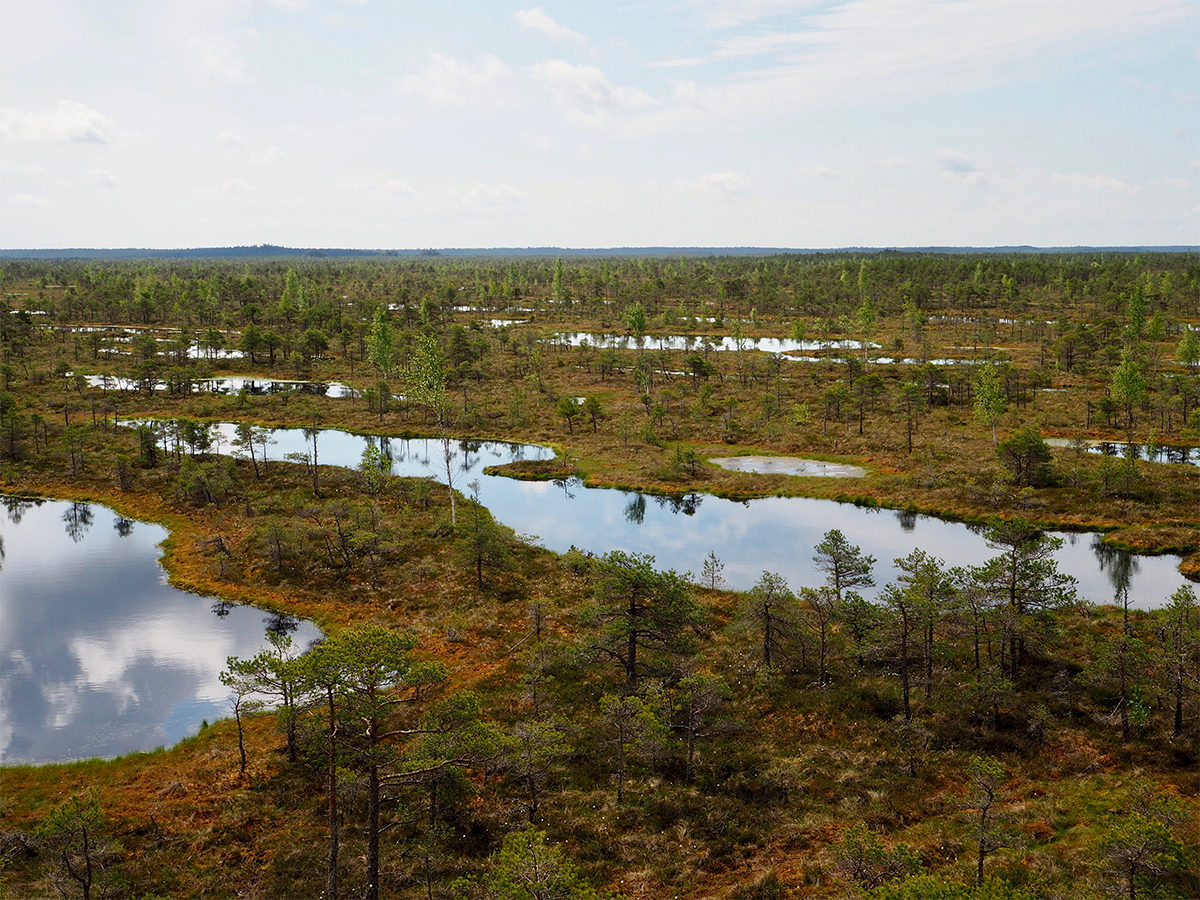
Natural peatlands have been drained for agriculture, forestry and peat extraction. Instead of storing carbon as they have done for millenia, they have become a major source of carbon emissions. In the European Union, 50% of peatlands are degraded. In Germany, only 5% of near-natural peatlands remain.

Peatlands Lakes in Great Kemeri Bog, Latvia
Peatlands Lakes in Great Kemeri Bog, Latvia/ GRID-Arendal/ Flickr 2.0 Generic (CC BY 2.0)

Besides rivers and peatlands, we also need to restore other ecosystems to a semi-natural or natural state, such as grasslands and forests.

Good news for European ecosystems – Restoration is possible and already happening

In Finland, we have successfully restored some of our wetlands that had been drained for tree plantations. We are on track to restore 12,000 hectares of ditched mires by 2023, thanks to increased government funding.

Many of Finland’s forests are in a poor condition, though. Around 225,000 hectares of natural boreal forest have been altered beyond recognition for use by the commercial forestry industry. They do not provide suitable habitat for many endangered forest species.

Only on 17,000 hectares, efforts have been made to restore these forests to a semi-natural state. This only happened after they were designated for protection.

In Germany, we have found a new way of financing wetland restoration through carbon credits.

These are good actions but we need to do more to save nature and our planet!

Big Timber – why the new nature restoration law is under attack

The logging industry lobby is already out to fight the new nature restoration law. They are more concerned about short-term profits than protecting precious ecosystems and habitats. Three forest industry associations – from Finland, Sweden and Estonia – have asked to only include forests in existing EU-protected areas in the new law. Other forests, they pretend, are doing well enough.

Now, it would be hard for anyone to argue that forests in protected areas are doing well. EU reports show that they are not. And that forests in the Nordic region (so-called boreal forests) are doing the worst of all EU forest types.

Across the EU, only 29 percent of EU forests are in “Natura 2000” protected areas. The condition of our forests outside these areas is also concerning.

In Germany, exceptional drought and bark beetle attacks degraded almost 5 percent of forests in just over three years. Researchers said this damage was “unprecedented”. They noted that neighbouring countries like the Czech Republic and Austria were facing similar challenges.

Whether or not forests are managed only for conservation or for wood production, we need to make them more resilient against climate-driven disturbances like droughts, fires and pests. We cannot allow short-sighted economic interests to undermine the long-term maintenance of our livelihoods. 

No more delays – we need a strong nature restoration law now!

As the Greens/EFA, we are glad that the EU is stepping up action to bring back nature. We have called for an ambitious proposal that effectively counters the biodiversity crisis. Together with many others, we have written to the Commission to set out our demands.

The war in Ukraine cannot be a reason to delay this action. Concerns about negative impacts on short-term food security are misplaced. In fact, without intact ecosystems, we will not be able to feed ourselves in the future. Protecting nature now means we can keep growing enough food in the long run.